THE SHORT VERSION
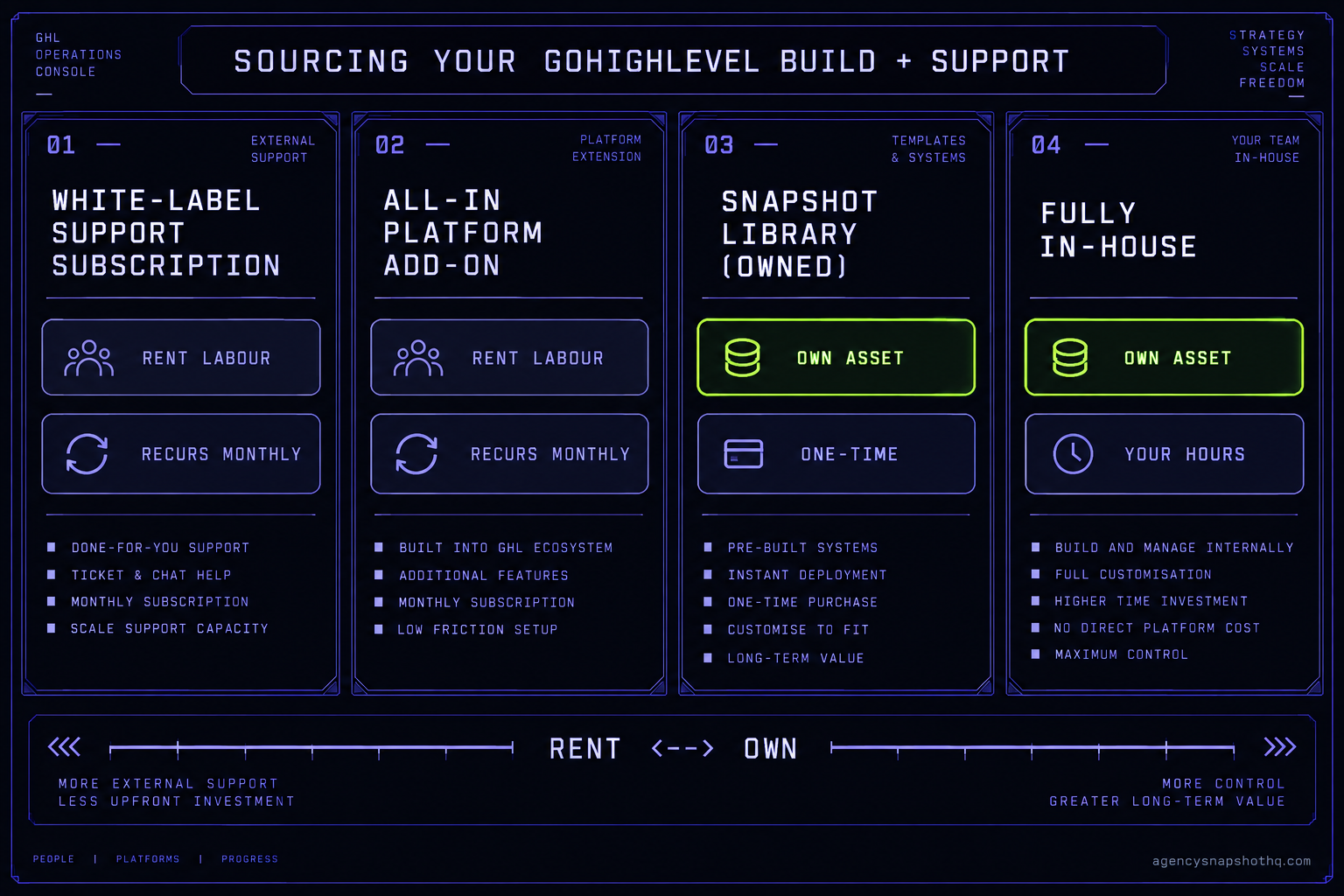
- There are four honest ways to source a GoHighLevel build and the support behind it, and they split on one line: are you renting labour that recurs, or buying an asset you own.
- A white-label support subscription answers your clients' tickets and never stops billing; a snapshot library hands you an asset you keep but still leaves you holding the support phone.
- Most of the support market is demo-gated: Extendly routes you to a call with no public rate, and even the providers that list a number disagree with each other, which makes the comparison hard on purpose.
- The recurring cost nobody totals is the one that decides it. A support subscription at a few hundred a month is a five-figure line over three years; an owned snapshot is a one-time number you can read off a page.
- The right answer changes with your account count: a solo operator rarely needs a support desk, and an agency drowning in client tickets rarely needs more snapshots.
It is a Tuesday night and the ticket says the client’s calendar stopped taking bookings. You have fourteen sub-accounts, you built eleven of them yourself, and you cannot remember which one of them you last touched the booking logic on. The client does not care about any of that. They want it fixed tonight, and you are the only person who can.
This is the moment that sends agency owners looking, and it is worth being honest about what they are looking for, because it is usually two different things wearing the same coat. One is the build itself: the pipelines, the workflows, the funnels, the nurture that you would rather not assemble from scratch for every niche you sell. The other is the person who answers that Tuesday-night ticket so it does not have to be you. The market sells both, sometimes bundled, sometimes separately, and the mistake that costs the most is paying for one when the gap you actually have is the other.
So this briefing is not about which snapshot to buy. It is about where to get your builds and the support behind them, and there are four honest answers. A white-label support subscription. An all-in platform add-on. A curated snapshot library you own outright. Or everything in-house, built and supported by you. They are not tiers of the same product. They solve different problems, they bill in different shapes, and the one that fits you depends almost entirely on how many accounts you run and who you want answering the phone.
What you are actually choosing between
Strip the marketing off all four and they line up on a single axis: are you renting labour that recurs, or buying an asset you own.
A white-label support subscription is labour. Providers like Extendly and HL Pro Tools put a branded support desk behind your agency, so when your client opens a ticket it is answered under your name by someone who is not you. Most of them also hand you a library of snapshots to install, and onboarding help to get accounts live. The thing you are really buying is the desk. It bills every month, for as long as you want the phone covered, and it stops the day you stop paying.
An all-in platform add-on is the same idea with a wider footprint. Growthable is the clearest example of this category, and it is the one almost nobody else in this corner of the market talks about. You get AI support tooling, white-label human support, onboarding hours, and a snapshot library, sold as plans that sit on top of your HighLevel account. It is still labour-plus-tooling that recurs, but it reaches further into the day-to-day than a plain support desk does.
A curated snapshot library is an asset. You buy the build for a niche, you own it, and you install it into as many sub-accounts as your plan allows. There is no desk behind it answering your clients, and that is the honest limit of the model: it hands you the thing, not the hours. What it gives you in return is ownership and a printed price. The build is yours to keep and reinstall whether or not you ever contact the seller again.
Fully in-house is you. You build each niche once, you support every account yourself, and you pay nothing to anyone except HighLevel and your own time. It is the cheapest model on paper and the most expensive in the one currency agency owners are shortest on, which is their own attention on a Tuesday night.
Two of these buy you people. Two of them buy you a build. Only one of the four, the in-house route, buys you neither and asks you to be both. Hold that split in your head, because every criterion below is really just a different way of asking which side of it you need.
The four models, compared
Here is the whole decision on eight criteria. The prices in the cost row are covered properly, with sources, in the arithmetic section below. Read the table for shape, not for exact figures.
| Criterion | White-label support subscription | All-in platform add-on | Curated snapshot library (owned) | Fully in-house |
|---|---|---|---|---|
| What you pay | Recurring monthly, often per client or per tier | Recurring monthly, plans plus setup | One-time per snapshot, or a yearly library plan | HighLevel plan only, plus your hours |
| What you get | A branded support desk, usually snapshots and onboarding too | AI tooling, human support, onboarding, snapshots | The build itself, yours to keep | Whatever you build |
| Who answers your client | The provider, under your brand | The provider, under your brand | You | You |
| Who keeps builds current | The provider refreshes its library | The provider refreshes its library | You, or a paid update service | You |
| White-label depth | High, the desk is the product | High, built for resale | You brand it yourself at install | Total, nothing to hide |
| Do you own it | Usually not, support stops on cancel | Usually not, the stack is theirs | Yes, the snapshot is yours | Yes, you made it |
| Time to first go-live | Onboarding call, then live | Onboarding, then live | Fastest from the shelf | Slow first, fast after |
| Best for | Agencies drowning in client tickets | Agencies that want one vendor for everything | Operators who want to own their builds | Solo or very technical operators |
The row that decides most arguments is “do you own it.” A support subscription and a platform add-on are brilliant at the thing they do, which is take the client-facing hours off your plate. But the moment you cancel, the hours stop and, very often, so does your access to the builds. An owned snapshot does not care whether you are still a customer. It is the difference between a gym membership and a set of weights in your garage. Both get you fit. Only one is still useful after you stop paying.
The other row worth staring at is “who keeps builds current.” A provider that refreshes its library is doing real work you would otherwise do yourself. If you own your snapshots, keeping them current is on you, which is a genuine cost, and it is exactly why an owned-library model usually pairs with either your own maintenance discipline or a paid snapshot update service to carry it.
Where each model breaks
Every one of these works until it doesn’t. Knowing the failure mode in advance is how you avoid paying to learn it.
The support desk that solved the wrong problem
An agency signs up for a white-label support subscription because they are exhausted by client tickets, which is the right reason. Three months in, they are still rebuilding a snapshot for every new niche by hand, because the subscription’s library did not cover the trades they sell, or covered them with builds they did not trust. The desk is answering tickets beautifully. The build problem it was never going to solve is still sitting on their desk. They bought labour when half their gap was an asset, and now they are paying monthly for the half they fixed while the other half bleeds hours. The tell, before you sign, is to ask what happens to the builds you install from their library if you leave, and to look hard at whether the library actually covers your niches or just the popular five.
The platform add-on whose ceiling you hit
A platform add-on sells on the promise of one vendor for everything, and it delivers right up to the edge of the plan you bought. The AI support tier that covers up to a few dozen sub-accounts is generous at first and then suddenly is not, the week you win three clients at once and cross the line into the tier above. Now the “all-in” price you budgeted around has moved, and because the tooling, the support and the snapshots are all the same vendor, you cannot drop just the part you have outgrown. You renegotiate the whole thing or you leave the whole thing. Bundling is convenient until the day you want to unbundle, and the failure mode is discovering that day was always coming and the contract was shaped so you could not see it.
The owned library that still leaves you holding the phone
This is the failure mode of the model this site sells, and it would be dishonest to skip it. You buy your niche snapshots, you own them, your builds are excellent and consistent, and at 9pm on a Tuesday your client’s calendar still breaks and you are still the one fixing it. Owning the asset did nothing for the labour. If the real pain that sent you looking was the support hours, a library is the wrong purchase, or at least an incomplete one. The honest fix is to stop treating the two as one decision: own the build, and separately staff the hours with a white-glove onboarding engagement or a dedicated VA, so the asset and the labour are solved by the right thing each.
The in-house build that drifted
In-house is free until it is twelve slightly different accounts that nobody can tell apart. You built the HVAC snapshot once, cleanly. Then you fixed a workflow in one client’s account directly because it was urgent, and never ported the fix back. Then you did it again, in a different account, differently. A year later there is no single source of truth for what “your HVAC build” even is, and every change is archaeology. This is version drift, and it is the specific tax on the model that looks cheapest, because the cost does not show up as an invoice. It shows up as the hour you lose every time you touch an account and cannot trust what you find. If you run in-house, the discipline that saves you is treating one master build as canonical and never editing live accounts without porting the change back, which is the whole subject of how snapshot drift happens and how to see it.
The demo gate that hides the comparison
This one is not a model, it is a condition of the market, and it breaks the decision itself. A real chunk of the white-label support world will not show you a price until you book a call. Extendly routes every prospective buyer to an onboarding conversation rather than a public rate card. Even the providers that do list numbers list them inconsistently across their own checkout pages and the third-party comparison pages, so the figure you find depends on which door you came in. The failure mode is that you cannot actually compare like with like, which means you either overpay because you never saw the alternative, or you stall for weeks because every option requires a sales call before it will quote. An agency that just wants to decide and move is quietly penalised for it.
The arithmetic nobody totals
Numbers here were confirmed against the providers’ own pages and third-party comparisons during research for this piece, by search rather than by direct fetch, and the figures move, so treat them as the shape of the cost rather than a quote. Where a provider will not publish a rate, that is noted as the finding it is.
Start with the floor everyone pays. HighLevel’s own platform runs about $97 a month for Starter, $297 for Unlimited, and $497 for the top SaaS tier, on a 14-day trial, per the published plan breakdowns (GHL Experts plan guide, SetSmart white-label guide). The white-label features most agencies want sit on the $297 Unlimited plan. That is your baseline before any sourcing decision, and it recurs no matter which of the four models you pick.
Now layer the support models on top. Growthable lists its white-label human support from $549 a month plus a $199 one-time setup at the Starter tier, rising through an Ultimate tier around $649 a month, with an AI plan from about $197 a month covering up to roughly three dozen sub-accounts on a short trial (Growthable pricing). HL Pro Tools surfaces support tiers on its own checkout pages, with a Core plan around $197 a month and an Elite plan at $997 a month for unlimited clients (HL Pro Tools Elite checkout), though its headline offer is gated behind a demo and third-party comparisons quote different splits. Extendly does not publish a flat rate at all; buyers book an onboarding call, and a third-party community guide puts a worked example near $415 a month, which is an estimate and not a posted price (GHL Central Extendly guide).
Here is the part that decides it. Run any of those monthly figures out three years. A $549-a-month support subscription is $19,764 over that span, before setup, and you own nothing at the end of it. A $997-a-month unlimited tier is $35,892. Even the sub-$200 entry tiers clear $7,000 across three years. These are not criticisms of the providers, who are selling real labour that real agencies need. They are simply what recurring costs do when you let them run, and the point of writing them out is that almost nobody does.
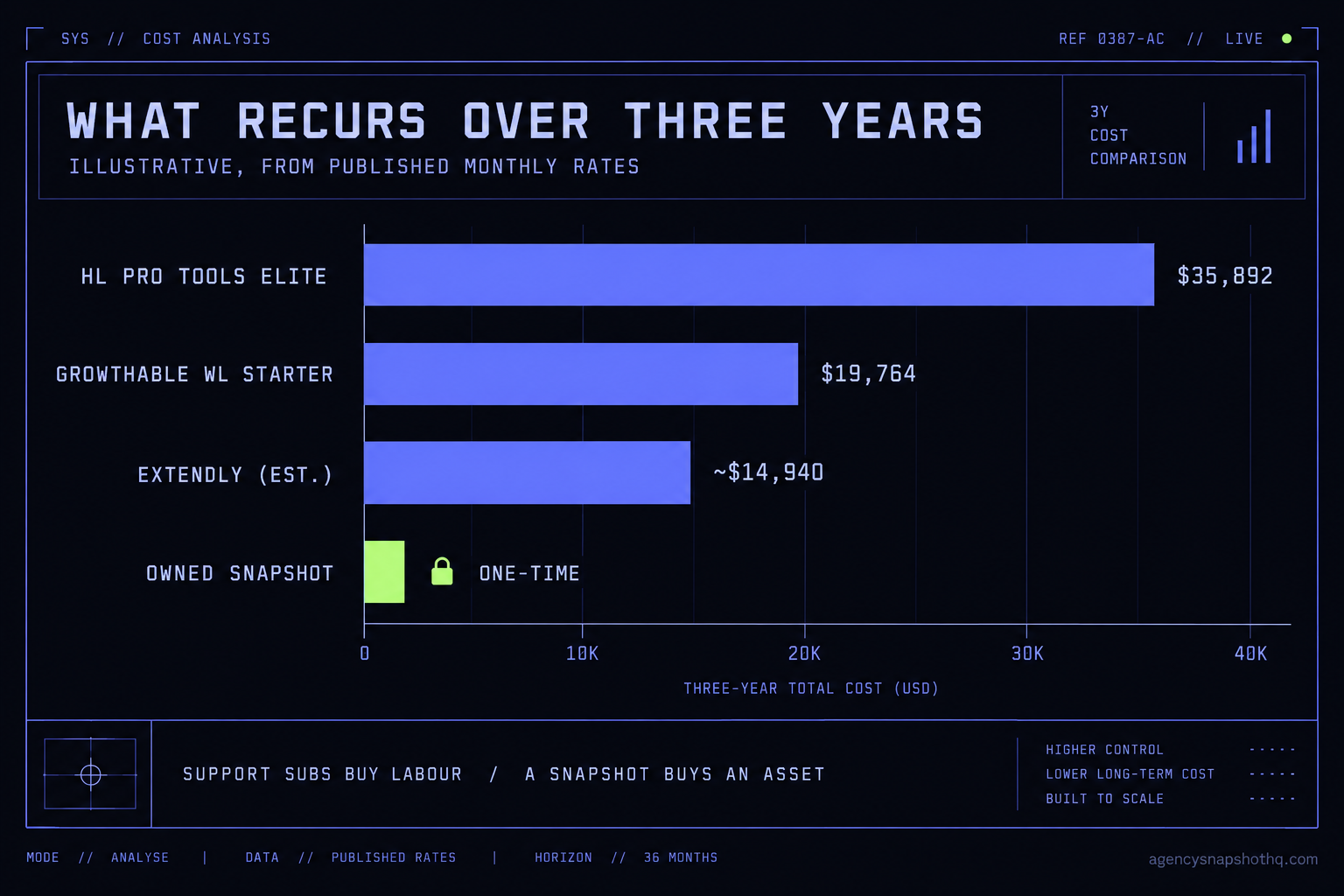
Against that, an owned asset is a one-time number. A single niche snapshot on this site runs from the high hundreds into the low thousands depending on niche depth, bought once and installed across every sub-account your plan allows, with the install included free and the share link landing within 24 business hours of purchase. The whole library on a yearly all-access plan is a known annual figure you can read off the pricing page. The arithmetic that matters is not “is a snapshot cheaper than a support desk,” because they do different jobs. It is “how long will I pay the recurring thing, and would a one-time asset plus the hours I actually need have cost less over that horizon.” Put your own monthly figure in, multiply by the months you realistically expect to stay, and compare that to owning the build and buying only the labour you genuinely cannot cover yourself. For most agencies under about ten accounts, that sum does not favour the all-in subscription, and the deeper version of it is laid out in when a snapshot library pays for itself.
The objections worth taking seriously
If this reads like an argument for owning snapshots, here are the strongest cases against it, including the one that should talk some readers out of buying from a library at all.
“A snapshot library does not answer my clients at 9pm, so it solves nothing for me.” This is correct, and if client-facing support is your actual bottleneck, a library is the wrong first purchase. The honest recommendation is to buy the labour: a white-label support desk or a platform add-on exists precisely so that ticket is not yours. Own the build if and when you want the asset, but do not expect a snapshot to cover a shift. Buying an asset to fix a labour problem is the same mistake as buying labour to fix an asset problem, just in the other direction.
“The subscriptions bundle onboarding and tooling I would otherwise have to assemble, so the monthly fee is buying more than support.” Also fair. A platform add-on that gives you AI tooling, a support desk and a snapshot library under one login is genuinely less to manage than sourcing three things from three places. The counter is ownership and exit. You are renting a stack that is not yours, and the day you leave you leave with nothing but your client list. Convenience now against portability later is a real trade, and plenty of agencies rightly choose convenience. Just choose it with your eyes open rather than because the alternative was never priced for you.
“Why pay anyone? I can build and support it all in-house for the cost of my HighLevel plan.” You can, and if you are technical and small it may be the right call for a while. But your hours are not free, they are just uninvoiced, and in-house carries the drift tax described above that compounds silently as your account count grows. The question is not whether you can do it. It is whether the hours it eats are worth more spent selling the next three clients, which is the same Saturday-versus-fee calculation that governs whether to deploy snapshots yourself or hand the rollout over.
Which one fits you
The verdict changes with your size, so here it is by operator rather than as a single winner.
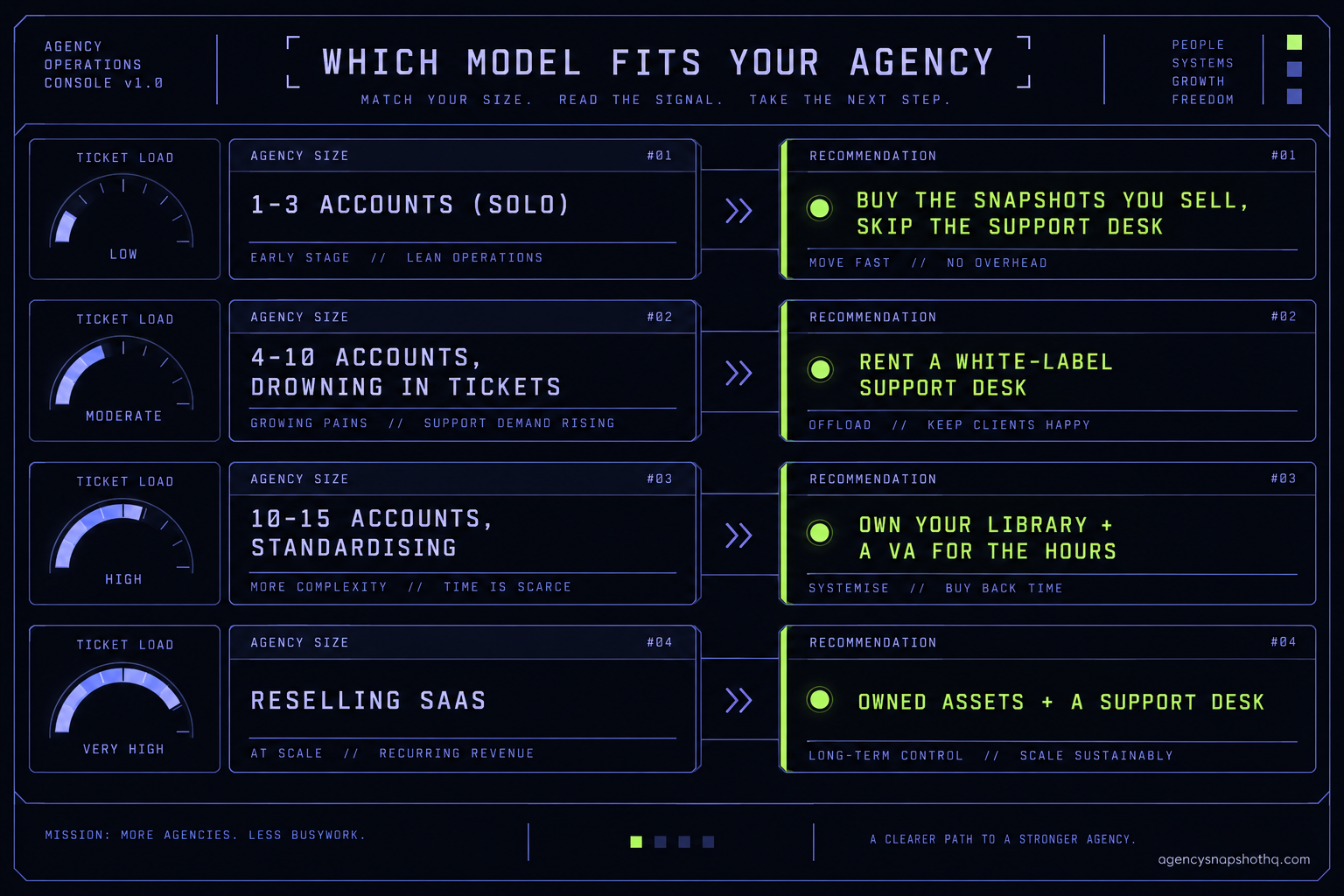
If you are a solo operator running one to three accounts, you almost certainly do not need a support desk yet, because the ticket volume is you handling your own small client base. Run HighLevel’s entry plan, buy the one or two niche snapshots you actually sell so the builds are yours, and keep the recurring spend off your books until the ticket load genuinely forces the question. A digital marketing agency snapshot or whichever niche you lead with is an asset that keeps earning after you buy it.
If you are a growing agency of four to ten accounts drowning in client tickets, this is the case a white-label support subscription was built for. The labour is your bottleneck, not the builds, so buy the desk and keep your snapshot sourcing separate, so you are not locked into one vendor’s library just to get support. Own your core builds, rent the hours.
If you are standardising across ten to fifteen accounts, own your library so every account runs the same canonical build, and solve the labour with a dedicated VA or a managed retainer rather than a per-client support fee that scales with headcount. At this size, version parity across the fleet is worth more than any single feature, and an owned, consistent set of builds, such as a trade like the HVAC contractor snapshot deployed identically everywhere, is what keeps the fleet legible.
If you are about to resell the platform as SaaS, you need the top HighLevel tier for rebilling anyway, and the sensible shape is owned assets plus a support desk, because your clients are now paying you for a product and the support expectation is no longer optional. Whatever you choose, make the two decisions, the asset and the labour, on their own merits. The vendors would prefer you treat them as one. They are not.
The thread through all of it is the line we started on. Rent labour when labour is the gap. Own the asset when the asset is the gap. The only expensive mistake is paying for the one you do not need because it came bundled with the one you do.