THE SHORT VERSION
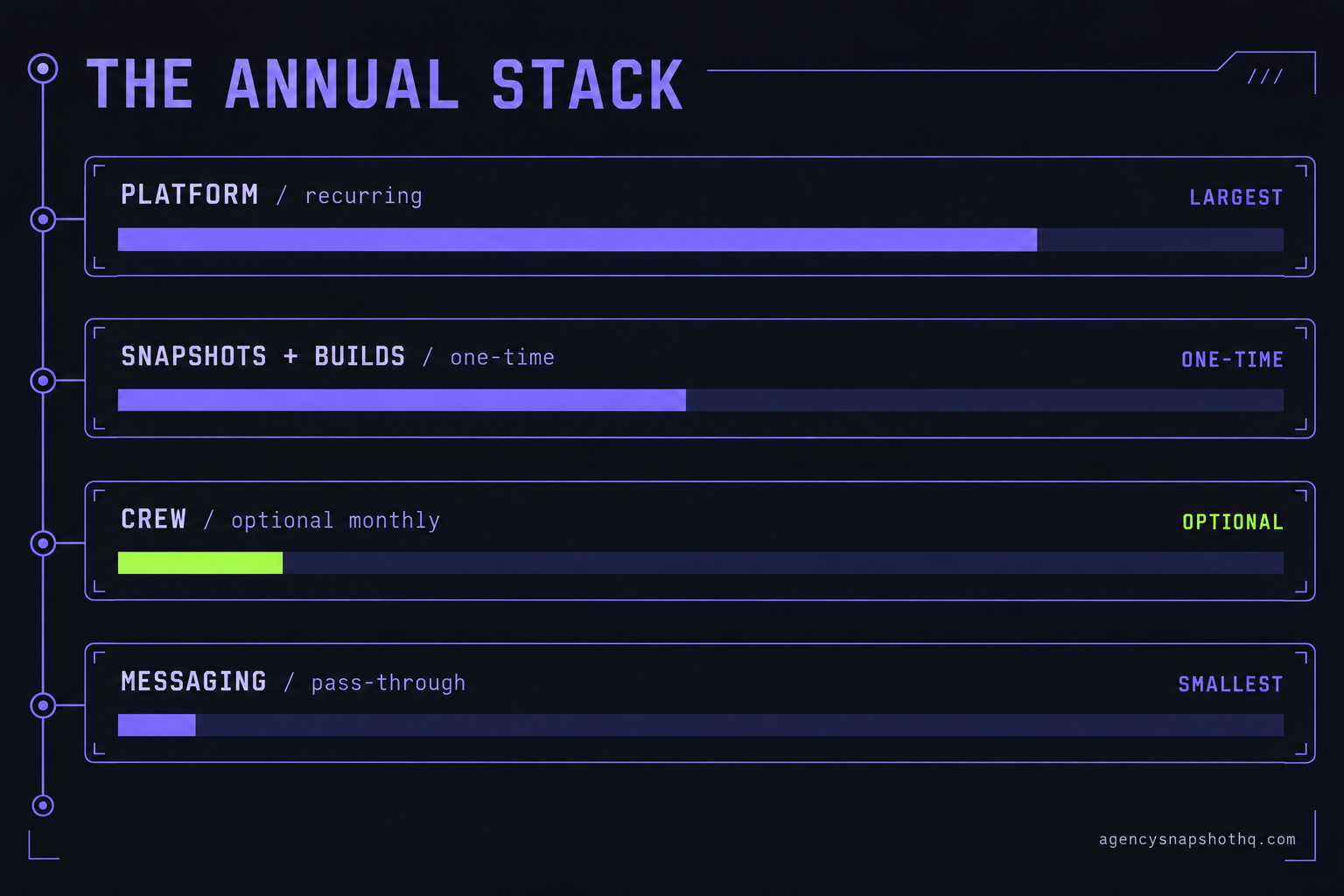
- The platform is the smallest line. HighLevel Unlimited runs $2,970 a year, and the cost per sub-account falls every time you add a client.
- Agency Pro's extra roughly $2,000 a year over Unlimited only buys something if you resell the platform under your own brand.
- A snapshot is a one-time cost to amortise across every sub-account in that niche, not a monthly subscription.
- The lines that actually leak are messaging pass-through you never rebilled and monthly help bought to do one-time work.
- Install is free and carries twelve hours of support inside a ten-day window. A free snapshot's real cost is the hours you spend rebuilding it.
It is the second week of the quarter and you are reconciling the agency card against the year. The HighLevel line is the one you expected, a little over four hundred dollars a month on the annual Agency Pro rate. Then the rest of it starts to surface. A virtual assistant invoice. Two snapshot purchases from the spring, one of which you installed once and never touched again. A messaging charge that climbed over the summer without anyone deciding it should. A domain renewal. A second tool you signed up for during a launch and forgot. By the time you have added the real rows, the number is nearly double the plan price you quote in your head when someone asks what GoHighLevel costs you.
That gap is the whole subject here. Not the sticker price of the platform, which is published and easy. The gap between the price you remember and the number that actually leaves your account over twelve months, and where inside that number a snapshot library or an outside build crew sits once you price it honestly. This briefing itemises every recurring line and every one-time line an agency running one to fifteen sub-accounts actually pays, in numbers you can check, so you can stop guessing at your own cost of operation.
The recurring layer, and which tier you actually need
The platform is the floor, and for most agencies it is also the smallest line once you divide it across clients. HighLevel publishes three plans. Starter is $97 a month, or $970 a year on annual billing, and it caps you at three sub-accounts with no platform white-labeling. Unlimited is $297 a month, or $2,970 a year, drops the sub-account cap, adds API access and a branded desktop app, and lets you rebill usage to clients at cost. Agency Pro is $497 a month, or $4,970 a year, and it is the only tier that turns on SaaS mode, where you resell the platform under your own brand and set your own prices. Every plan carries a 14-day free trial, and annual billing works out to roughly two months free against paying month to month. Those figures are HighLevel’s own, published on HighLevel’s pricing page and listed the same way in third-party plan comparisons.
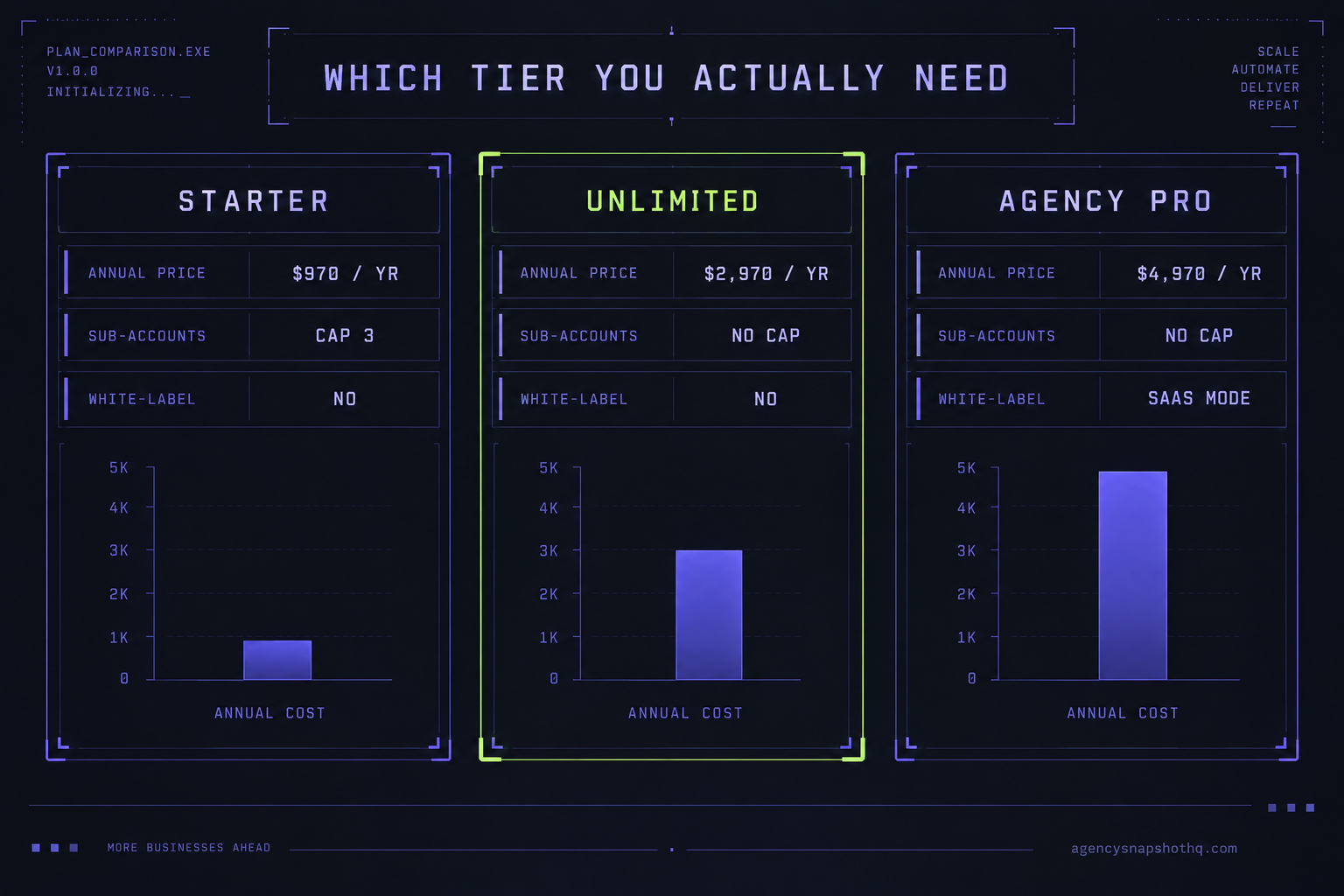
Two things about that table decide most of your recurring spend. The first is the sub-account cap. Three accounts on Starter is the ceiling the moment you take on a fourth client, which is why almost every agency past a couple of clients is on Unlimited whether or not they meant to be. The second is SaaS mode. Agency Pro costs about two thousand dollars a year more than Unlimited, and that premium buys exactly one capability: reselling GoHighLevel itself as your own software. If you are running client accounts and billing for marketing work rather than reselling a platform, Unlimited is your real floor and Agency Pro is money sitting idle.
Then the usage sits on top. SMS, email, phone calls and the AI features are billed by consumption, above the plan price, and third-party guides put the typical real bill somewhere in the range of twenty to a hundred and fifty dollars a month higher than the base depending on volume. The important detail is not the exact figure, which depends entirely on how much your accounts send. It is that this is a pass-through cost, and Unlimited and Agency Pro both let you rebill it to the client who generated it. Eaten, it is a slow leak on your margin. Rebilled, it is neutral.
Here is the part agencies miss when they fear the platform price. It is flat. Unlimited is $2,970 a year whether you run two sub-accounts or twelve. Spread across five clients that is $594 per client per year. Across fifteen it is $198. The platform does not get more expensive as you grow, so the more accounts you run on one subscription, the cheaper the floor becomes per client. The platform is rarely the line worth worrying about. The lines above it are.
The one-time layer, and why it hides
A snapshot is not a subscription, and that is exactly why it disappears from your mental model of cost. You pay once, you install, and it never shows up again, so it never gets amortised against the accounts it serves. It should be.
Our own snapshot prices run from $890 for the childcare centre build to $2,490 for the SaaS company build, priced by how much wiring the niche needs. You buy a niche once. A snapshot you bought for a plumbing client installs into every plumbing sub-account you ever run, under the same Unlimited or Agency Pro licence, at no extra platform cost. So the honest way to carry a $1,490 HVAC Contractor Snapshot is not as a $1,490 expense against one client. It is as a one-time cost divided across every HVAC account it will ever sit in, over the years it keeps working. The install is free with every snapshot, and it carries twelve hours of dedicated installation support to be used within ten days of purchase. Those twelve hours cover installing the snapshot, rebranding the website, A2P and 10DLC registration and setup, email domain setup, and a few extra automations where you need them. Spend the hours or let the ten days pass, and anything further is quoted as paid work. You are buying hours inside a window, not open-ended help, and it is worth budgeting that way.
Above the single snapshot sit the heavier one-time options, each of which is a different answer to the same question of how much of the build you want to do yourself. A custom snapshot build starts at $4,500 when no library niche fits what you are selling. White-glove onboarding is $2,500 and runs fourteen business days, for when you want the first full build done with you rather than by you. A fully deployed agency account, the Deployed plan, is $6,950 and hands you a finished account. And HQ All-Access is the one recurring exception in this layer: $4,950 a year, annual only, for the whole snapshot library instead of buying niches one at a time. We covered exactly when that math flips in the snapshot library break-even piece, and the short version is that it pays the moment you will deploy more than a few niches.
The one-time cost that hides best of all is your own time. Every build you do yourself is discovery, rebuild, registration, testing and training, and those hours are real even though no invoice records them. The only honest way to compare a DIY build against a bought one is to put your own billable rate on the hours the DIY path eats. We will do that in the arithmetic below, with the rate left as a number you fill in, because it is the single figure that decides which path is actually cheaper for you.
Where the stack actually leaks
A GoHighLevel agency rarely overspends on one big obvious line. It leaks, in five predictable places, and every one of them is a row you can close this week.
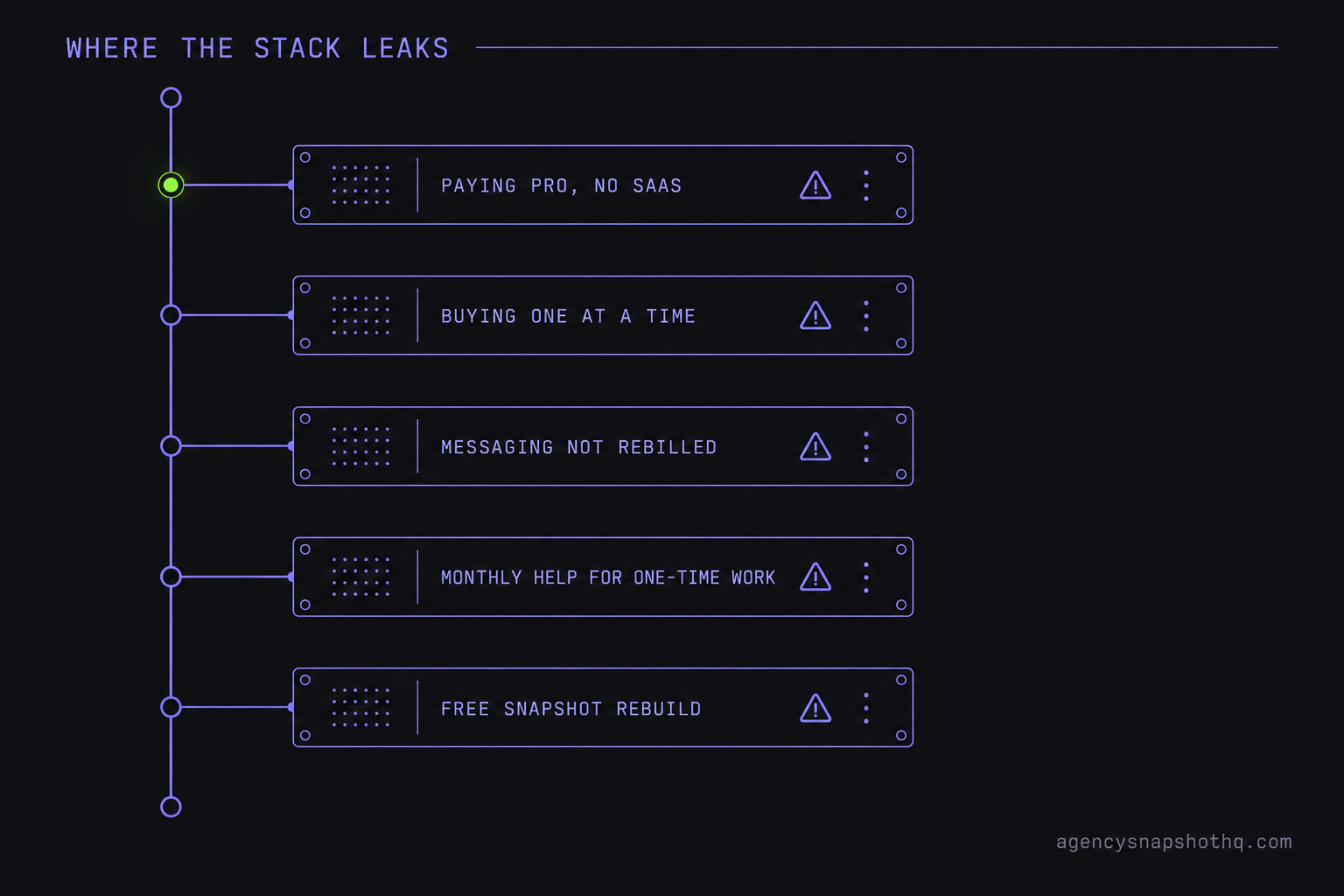
You are paying Agency Pro and never turned on SaaS mode
What you see is the $497 a month line, the one that feels like the cost of being a serious agency. What is actually wrong is that the premium over Unlimited buys SaaS mode and nothing else, and if you have never configured a SaaS plan and resold the platform under your own brand, you are paying about two thousand dollars a year for a feature that is switched off. The fix is a sentence long: if you do not resell the platform, move to Unlimited. That difference is more than a full snapshot, every year, recovered for nothing.
You are buying snapshots one niche at a time past the break-even
What you see is a growing row of individual snapshot receipts, each one sensible on its own. What is wrong is that past a handful of them, the $4,950 HQ All-Access library is cheaper than the sum, and every niche after that point is then free to you. The fix is to run the break-even before the next purchase, not after. One caveat worth stating plainly, because it is a common error: All-Access membership takes twenty percent off the services rate card, and that discount applies to services only. It is never applied to a snapshot price, because twenty percent off a snapshot would drop it through the floor, and the floor is deliberate.
You are eating messaging that you were allowed to rebill
What you see is the HighLevel usage charge climbing quietly over a busy quarter. What is wrong underneath is that A2P and 10DLC messaging carries real external costs, a brand registration, a per-campaign monthly fee set by the registry, and a carrier pass-through on every message, charged by Twilio and the Campaign Registry rather than by us or by HighLevel. The amounts change and are set by those providers, so the figure for your account is the one on your own carrier invoice, and the current fee schedule lives in Twilio’s A2P 10DLC documentation. The leak is not the cost itself, which is unavoidable if you text at all. It is eating it instead of rebilling it. Unlimited lets you rebill usage at cost and Agency Pro lets you mark it up, so a dollar of carrier cost should be a dollar you recover, not a dollar off your margin.
You bought monthly help to do one-time work
What you see is a GoHighLevel VA at $1,150 a month, or a managed retainer at $1,450 a month, carrying work that recurs by the day. What is wrong is when that monthly spend is actually covering a one-time build, hand-assembling follow-up sequences and review requests and reminder flows that a snapshot ships already wired. You are renting, every month, something you could own once. The fix is to separate the two honestly: buy the snapshot for the assets that only need building once, and keep the VA or retainer for the work that is genuinely recurring, the inbox triage and the live campaign management a static snapshot cannot do.
The free snapshot was never free
What you see is a zero on the invoice, which is the whole appeal. What is wrong is everything the zero hides. A free snapshot typically arrives with workflows wired to custom values that were never created, a calendar still pointed at the builder’s own Google account, and an A2P brand that was never registered, so nothing sends the first time a real lead comes in. The cost is the hours you spend tracing all of that, plus the client call where you explain why the number went dead on day one. Price those hours at your rate and a paid snapshot with a free install and twelve hours of support behind it is very often the cheaper object, not the more expensive one. Free is a price on the asset, not a price on the outcome.
The arithmetic, with your own numbers
Numbers only mean something with the assumptions printed beside them, so here are mine, and you should swap in yours. Assume you run seven sub-accounts, you do not resell the platform, and you will win three distinct niches this year. Your billable rate is a figure only you know, so it stays as a blank you fill in.
Start with the recurring floor. Unlimited is $2,970 a year, and because it is flat, seven accounts put the platform at $424 per account per year. That is the cheapest line in the whole operation, and it gets cheaper with every client you add.
Now the one-time layer. Three niches, bought as single snapshots, might be the HVAC Contractor Snapshot at $1,490, a dental build at $1,590, and the Salon & Barbershop Snapshot at $940. That is $4,020, paid once. If you expect to win more than three or four niches over the next couple of years, the $4,950 HQ All-Access library is the better buy, because niche four and niche five then cost you nothing. Three niches is roughly the hinge where the library starts to win, which is why I set the example there.
Add the two together and a seven-account agency running its first year on bought snapshots and a free install has a platform-plus-snapshot cost of about $6,990, before messaging. Divided across seven accounts that is just under a thousand dollars per sub-account for the first year, with the platform rebilled usage flowing straight back out to the clients who generated it. The number that matters more is year two. The snapshots are already paid, so year two is the platform alone, $2,970, until you add a new niche. The one-time layer stays one-time. That is the entire case for treating snapshots as assets rather than subscriptions: they stop costing you money while they keep doing the work.
What are those assets meant to return? The system’s targets, stated as targets and not as a measured promise, are a seventy percent no-show recovery rate on booked appointments and five to ten reviews a month per account from the review automation. Put your own average client value against a seventy percent reduction in no-shows across seven accounts and the recurring platform line stops looking like a cost at all. It looks like the smallest input in the stack.
Three objections worth taking seriously
“I can build all of this myself for the price of my own time.” You can, and if you genuinely enjoy building and have the hours spare, that is a real answer rather than a wrong one. The honest version of the argument is the one with your rate filled in. When the hours a build eats, priced at what you bill clients, cost more than the snapshot, buy the snapshot. When they cost less and you want the practice, build it. The mistake is pretending the hours are free because no invoice names them.
“Your snapshots cost more than the free ones and the cheap sellers.” They do, on the sticker. The floor here is $850, and we do not sell below it on purpose, because a snapshot sold cheaper than that is almost always one that lands needing a rebuild you pay for in time. If you have a cheap or free snapshot you fully trust and can install clean in an afternoon, use it, genuinely. The case for paying more is narrow and specific: a build that imports without rewiring, a free install, and twelve hours of support to lean on inside the window. You are paying for the hours you do not spend, which is only worth it if your hours are worth something.
“All-Access is $4,950 up front, and that is a lot to commit.” It is, and it is annual only, so it is a real decision rather than a trial. If you will only ever serve one niche, do not buy the library, buy that one snapshot and keep the rest of the money. All-Access is for the agency that will keep adding niches, where the library turns every future build into a download instead of a purchase. Matching the plan to how many niches you will actually run is the whole skill, and buying the bigger plan when the smaller one fits is its own kind of leak.
“I would rather put it all on a retainer and stop thinking about cost.” Plenty of operators feel this, and a managed retainer at $1,450 a month is a legitimate line when fulfilment genuinely recurs. What it is not is a substitute for owning the assets underneath. A retainer buys someone to run the machine. It does not replace the platform subscription the accounts sit on or the snapshot that supplies the workflows, so paying a retainer while skipping the one-time build means you are now paying monthly for the running and still missing the thing being run. The clean structure is both halves kept separate: own the platform and the snapshots once, and pay the retainer only for the hands-on work that actually repeats week to week. Bundling the two into one comfortable monthly number is how the stack quietly grows past what the work needs.
Add it all up and the picture inverts the worry most agencies start with. The recurring platform, the line people fixate on, is the cheapest and most predictable part, and it falls per client as you grow. The spend that actually decides your margin is one-time assets bought at the right scale and the monthly help bought only for work that truly recurs. You can see the whole library and the full rate card on the pricing page, and the fastest way to shrink the gap between your remembered cost and your real one is to put every line in this briefing against your own card statement tonight.